
A stack of towels waiting at closing time, uniforms that need to be ready before the next shift, or sheets that cannot miss a guest check-in can turn laundry into a daily operational problem. The choice between commercial versus inhouse laundry is not just about who washes the load. It affects your staff’s time, your available space, your utility bills, and the consistency your customers see.
For some Long Island businesses, keeping laundry in-house is the right call. For others, a dependable commercial laundry partner removes a major source of stress. The best option depends on your volume, schedule, standards, and the real cost of managing laundry when no one is watching the machines.
Commercial Versus Inhouse Laundry: Start With the Real Work
In-house laundry means your business owns or leases the machines, buys the supplies, and has employees handle washing, drying, folding, and storing. It can give you direct control over every cycle. A salon may want to wash color-stained towels right away, for example, while a small fitness studio may prefer having clean towels available throughout the day.
Commercial laundry service moves those tasks to a professional provider. Your staff collects the items, and the laundry service handles cleaning, drying, folding, and scheduled return. This approach is especially useful for businesses with regular linen, towel, uniform, or apron needs and little extra time to manage them.
The decision is not always all or nothing. A business with an occasional rush may keep a few necessities on-site while sending its larger, recurring loads out. That can be a practical middle ground when space is tight but immediate access to a few clean items still matters.
The True Cost of Keeping Laundry In-House
An on-site laundry room can look less expensive at first because you are not paying a per-pound or per-bag service price. But the purchase price of machines is only the beginning. Commercial washers and dryers require installation, ventilation, plumbing, gas or electric connections, maintenance, and repairs. They also take up valuable square footage that could be used for customers, inventory, treatment rooms, or staff work areas.
Then there are the ongoing costs: water, electricity or gas, detergent, stain treatments, replacement parts, and machine downtime. A dryer that stops working before a busy weekend does not just create a repair bill. It can leave your team scrambling to find clean towels, linens, or uniforms when they need them most.
Labor deserves an honest look, too. Someone has to sort loads, start machines, move wet items, fold everything, keep supplies stocked, clean lint traps, and put items away. Even when each task only takes a few minutes, the time adds up across a week. If a manager or front-desk employee is doing laundry between customer requests, that distraction has a cost of its own.
In-house service may still make financial sense when volume is very high, laundry must be available several times a day, and you have the space and staff to support a well-run laundry operation. The key is to count more than the price of detergent.
When Commercial Laundry Makes More Sense
Outsourced laundry is often the simpler choice for businesses that need predictable results without adding another job to the team. Restaurants, salons, gyms, medical-adjacent offices, spas, short-term rentals, and hospitality businesses all depend on clean items that are ready when needed. When the workload is steady, scheduled pickup and delivery can turn laundry from a constant chore into one less thing on the daily checklist.
A commercial provider also brings capacity. Instead of waiting for two or three on-site machines to finish, larger volumes can be processed without tying up your premises. That matters during busy seasons, special events, staffing shortages, or periods when your laundry needs suddenly grow.
Consistency is another major benefit. Customers notice a fresh towel, a crisp uniform, and clean linens. They also notice when supplies run short or items come back with stains, odors, or poor folding. A reliable commercial laundry service should follow your instructions, separate items appropriately, use the products that fit your needs, and return the order ready to use.
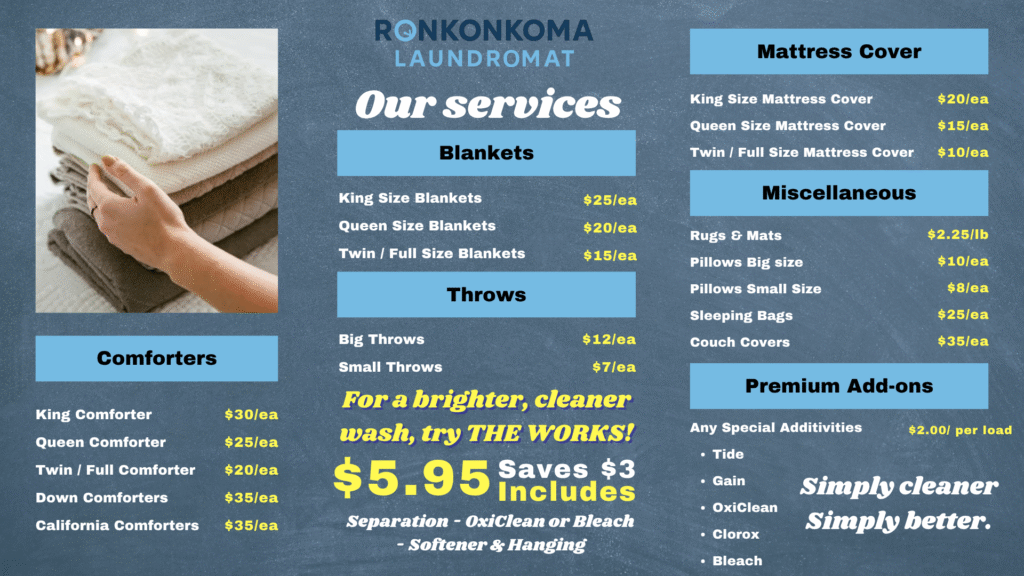
For businesses in and around Lake Ronkonkoma, Ronkonkoma Laundromat offers commercial laundry support with dependable pickup and delivery, caring handling, and a satisfaction guarantee. If a load does not meet the agreed standard, it will be re-washed free. That kind of accountability is helpful when your own reputation is attached to every clean item you hand a customer.
Compare Control, Convenience, and Capacity
The biggest advantage of in-house laundry is control. You can decide exactly when a load starts, which products are used, and how items are stored. If your business frequently needs a small number of items cleaned immediately, that access can be valuable.
But control is only useful when you have the staff and equipment to carry it out consistently. A machine sitting idle because no one has time to load it is not really giving you control. Neither is a back room packed with damp towels waiting for a staff member to finish folding.
Commercial laundry gives you a different kind of control: control over the outcome and the schedule rather than every step in the process. You set the pickup plan, communicate preferences, and know when clean items will return. Your team can focus on guests, clients, patients, food service, or the work that brings people through your door.
Capacity should guide the conversation, too. Calculate how many pounds, bags, towels, uniforms, or linen sets you process in an average week. Then look at your busiest week, not just your quietest one. Your plan needs to work when business is good, not only when there is plenty of time and room to spare.
Questions to Ask Before You Choose
Before investing in machines or signing up for a commercial service, look at your operation with a practical eye. How quickly do you need items returned? Do you have enough room for dirty-linen storage, clean-linen storage, and equipment? Who is responsible when a staff member calls out or a machine breaks? How much employee time is spent on laundry every week?
Also consider the type of items you process. Heavily soiled restaurant towels, salon capes, gym towels, uniforms, bedding, and delicate garments may require different handling. A good provider will ask questions about your load rather than treating every bag exactly the same.
Ask about turnaround times, pickup reliability, minimums, folding standards, special product requests, and what happens if something is not right. The cheapest option is not always the most affordable if it causes shortages, rework, or frustration for your staff.
Make Laundry Support Your Business, Not Slow It Down
The right choice should make your day easier. If in-house machines are reliable, your team has room to work, and immediate turnaround is essential, keeping laundry on-site may support your operation well. If laundry keeps pulling staff away from customers, filling valuable space, or becoming a recurring headache, outsourcing can be a smart, worry-free change.
Clean towels, linens, and uniforms should help your business feel prepared and professional, not create a pile of unfinished work at the end of every shift. Choose the setup that lets your team spend less time chasing loads and more time taking care of the people who count on you.